I am a white elephant

Tags

, , , , , , ,

I know now that a white elephant is a rare thing. It means good luck. In many Eastern Asian cultures the more white elephants a king has, the richer and happier he is. A white elephant is a precious thing to be cared for and nurtured. But when I was a middle schooler and was called Sunil’s white elephant, it didn’t seem so positive.

I met Sunil at summer camp. He was from India. A bright-eyed and happy kid, Sunil was fun to be around and we became friends quickly. But when he started referring to me directly and to others as his white elephant, I was offended. He seemed to follow me around and tried to always be near me. He sat by me at meals, came to my cabin, and waited for me after campfire. In hindsight he clearly liked me but i was oblivious. He was, after all, referring to me as an elephant, so why would i think he liked me? He tried to explain what he meant but being referred to as an elephant of any kind was just not a good thing in my 13-year old mind. And I became embarrassed and pulled away from him.

Now, knowing what I know about white elephants and people in general, I realize he was paying me a wonderful compliment! And I feel bad for him and for us because I never really gave him the chance to explain what he was trying to say and I never gave myself the chance to fully get to know him.

So he saw my 13-year old self as a precious and rare thing to be nurtured and cared for and treasured. I wish I had realized that then! It took me years to realize these things about myself. I wonder how different I would be today if I had realized those valuable truths back then!

It just might be the most beautiful name anyone has called me: a white elephant.

Musings of a wanderer

Tags

, , , , , , ,

I’ve been traveling to where other people consider ‘strange places’ for years; since 1992. And after all these years the reaction from others is still the same: Why are you going there? Or, You’re traveling again? Or, Don’t you ever work? Better (or worse) yet, they say, “I wish I could travel.”

I can’t figure it out. I get mixed messages from those who ask these questions as if they’re angry I’m leaving again or they’re jealous that it’s not them. “What are you running from?” they ask me knowingly, like they’re certain they’ve caught me and there must be some big sadness or woe I seek to escape. “I’m running toward, not from,” I say when given the chance. To which I receive a blank stare.

‘But there’s so much to see in the United States! Why would you need to travel anywhere else?’ ‘Aren’t you scared traveling alone?’ ‘I can’t travel because my husband/wife/partner doesn’t like to travel.’ ‘I’d travel but I don’t have the money.’ ‘I would never go there!’ ‘Don’t you just want to stay at home?’ And on and on…

And by the way, people who tell me they wish they could travel: you can travel! If it’s a priority for you, you can do it. And also, people who ask me if I ever work or if I’m still on vacation: I get multiple weeks each year from my employer to use as I see fit. I’m not going to forfeit those days.

I don’t care what other people think of me and my travels. I really don’t. But getting bogged down with these kinds of conversations has made me clam-up and not discuss travel plans or travel in general with people; especially at work. Why would I want to invite such comments from people?

I’m long over thinking that I can change other people’s attitudes with one single comment. So I blog. I write my experiences down and post them, assuming that the people who read them will already be somewhat interested in the topic to be reading about travel in the first place. And those who don’t understand either will come to accept it about me, or not. It won’t matter to me because it won’t change what I do. And it won’t change what I love.

I get the most defensive when people assume my travel interferes with my work as a sales rep. I cover three large states in the US and am on the road a lot just for work. I work many hours a day (and night!) because my work is always with me no matter where I am. I’m reachable by phone(s), text(s), email(s) and am talking all day long in dental offices. I’m constantly on. And the fact that I’m unmarried and have no children means I have that much more time to devote to work. And it means that I’m the only one who can get my stuff done for myself between business trips: laundry, mail/bills, errands in general, food shopping, maintenance, etc. So life can be crazy. I don’t only want to travel, I need to do it. And I’m tired of taking flack for it.

It seems to be virtuous in the circles I’m in to forfeit vacation. To give the appearance that I couldn’t possibly take vacation because I’m too integral to the success here. Or to give the appearance that I’m such a hard worker and am so dedicated to this job. When really it might be that people just don’t know what they’d do with themselves for more than a few days off at a time! I’ve never been so relaxed as when I’m on vacation, away from home, for longer than one week. It’s remarkable how relieved and light one can feel after no thoughts of work or home.

Don’t get me wrong, there can be negatives for traveling and I’ve been penalized greatly for my travels. It still surprises me it happened. Once a co-worker stepped in while I was gone and worked her way in to a job I was interviewing for using my time away/vacation as a way to disparage me. Another time I was demoted after taking a three-week vacation (for which I was given approval) because I used poor judgment taking that much time off. (At the end of the year and when not even using all of the vacation time due me, by the way!) So there can be a price to pay. But it’s worth it to me. I am a changed person after every trip. I am fuller and happier and more settled. It’s what makes me who I am.

The point is, everyone can travel. It doesn’t matter where you go or what you do. You can travel. You can travel in your own city! Pretend you’re a visitor and see the place you know and live with fresh eyes! Plan a trip in your own state and see something you’ve never thought to visit before. Go to a neighboring state for a weekend. Try new foods. Be open to new activities. All of that, to me, is considered traveling. Say yes to travel! Define it your own way – – and just do it! Be open to the things the world shows you and teaches you. You’ll never be the same.

Ramadan in Morocco

Tags

, , , , , , , , , , , , , ,

Ramadan is the most important holiday in Islam. It’s probably most like the Christian Lent, but the two don’t really compare. Ramadan symbolizes when the Qur’an was revealed to Mohammad. It occurs every year in the 9th month of the 12-month lunar calendar. Lunar months are shorter than Gregorian months by 12 days so Ramadan is earlier in each Gregorian year.

This year Ramadan is 9 July, 2013 – 8 August, 2013. But the bottom line is: Ramadan requires abstention from food, drink (even water!), sex, and smoking. During daylight hours. The point of it is to show devotion to Allah and to become a master of self-discipline.

Some people view it as recognizing the hunger and thirst that the poor feel every day of the year and to suffer it in silence and, hopefully, to become a kinder person for it. But from what I gather, it ends up being a contest with oneself or others of endurance! The weather is particularly hot during Ramadan and in 2012 it seemed to be nearly unbearable even in the beginning, only getting worse as the month wore on. Old people, children, pregnant women and others are exempt from this practice of abstention, but I notice from stories I’ve heard that even they press on out of devotion or whatever drives them…

The fast is broken when the sun officially sets and is broken usually with dates and milk. Or harira and dates. Harira is a soup made from tomatoes and lentils. It is served in Morocco year-round but is especially popular during Ramadan. A few more meals are eaten throughout the night so that everyone is nourished for the next morning when the whole thing starts all over again.

Everything moves at a different pace during Ramadan. And from what I’ve heard, people become edgy, groggy and increasingly irritated. All of this is followed by Eid Al Ftar, a festival to break the fast for the year. According to Wikipedia, here’s some more information I find interesting:

“Typically, Muslims wake up early in the morning—always before sunrise— offer Salatul Fajr (the pre-sunrise prayer), and in keeping with the traditions of the Prophet Muhammad clean their teeth with a toothbrush, take a shower before prayers, put on new clothes (or the best available), and apply perfume. It is forbidden to fast on the Day of Eid. It is customary to acknowledge this with a small sweet breakfast, preferably of the date fruit, before attending a special Eid prayer (known as salaat).

As an obligatory act of charity, money is paid to the poor and the needy (Arabic: Sadaqat-ul-fitr) before performing the ‘Eid prayer:
To show happiness
To give as much charity as is possible
To pray Fajr in the local Masjid
To go early for Eid salaat
To read the takbirat in an open field.
Go to the Eid prayer on foot
Do not speak one word other than words that remember Allah or anything Islamic terms before and after Eid Salaat. You can speak once you’ve left the Masjid, or Mosque or any other place you were praying
Say ‘Eid Mubarak’ to other Muslims
Muslims recite the following incantation in a low voice while going to the Eid prayer: Allāhu Akbar, Allāhu Akbar, Allāhu Akbar. Lā ilāha illà l-Lāh wal-Lāhu akbar, Allahu akbar walil-Lāhi l-ḥamd. Recitation ceases when they get to the place of Eid or once the Imam commences activities.
Muslims are recommended to use separate routes to and from the prayer grounds.
The Eid prayer is performed in congregation in open areas like fields, community centers, etc. or at mosques. No call to prayer is given for this Eid prayer, and it consists of only two units of prayer with an additional six incantations. The Eid prayer is followed by the sermon and then a supplication asking for God’s forgiveness, mercy, peace and blessings for all living beings across the world. The sermon also instructs Muslims as to the performance of rituals of Eid, such as the zakat. Listening to the sermon at Eid is a requirement i.e. while the sermon is being delivered; it is prohibited to talk, walk about or offer prayer. After the prayers, Muslims visit their relatives, friends and acquaintances or hold large communal celebrations in homes, community centers or rented halls. Eid gifts, known as Eidi, are frequently given at eid to children and immediate relatives.”

So this is Ramadan and the celebration of Eid afterward to break the fast. It is both eagerly anticipated and dreaded. While people are reverent, they also become impatient, irritated, edgy, and angry. It is, it seems to me, a month of extremes. Extreme heat. Hunger. Thirst. Exhaustion. A month of prayer. Gorging. And whatever else goes on when it’s not daylight.

I admire the dedication to this holiday. And I’d like to see just once if I could do it. But it seems impossible to not eat or drink water when temps can rise to 45 degrees! (over 100). I can’t even see me lasting two days, honestly. But someday I’d like to try.
Couscous Friday

Tags

, , , , , , , , , , , , , , ,

Friday in Morocco means one thing: couscous.

The national dish is made in households across Morocco every week and is greatly anticipated. Fridays are traditionally considered a holy day in Morocco and many businesses are closed for the day or afternoon – – or at the very least, a long, long break in the middle of the day for mosque (for the men). Life takes on a slower pace on Fridays. And at the same time there’s a sense of urgency about everything: “We better get to the bank before mosque. It’s Friday!” “We have to hurry to the tire store to get new tires this morning. It’s Friday!” “I couldn’t mail the package to you. It’s Friday.”

Couscous is the best part of Friday. It’s made in restaurants and at home and it seems everyone looks forward to it this week just as much as they did the last week. Moroccans seem to love their couscous even more than the ubiquitous tajine.

When eating couscous with my friend’s family last month, the family commented how long they’d had their couscous serving dish: 12 years. The 15-year old daughter commented that ‘it’s like my little sister!’

The process for couscous is not a small or quick task. Vegetables need to be cut and sliced to the correct sizes, meat (usually lamb) needs to cook until tender, and the couscous itself (semolina: tiny granules of durum wheat) requires a tender process of cooking and stirring – – almost kneading – – until it reaches its perfection. This requires pouring hot water over the grain and “stirring” it with your hands and then putting it back in the pot and repeating the process 15-20 minutes later, 5 or 6 times. It’s a hot, steamy business, this couscous-making.

Finally, the ingredients are all added together in specific order (meat in the middle of the dish itself, couscous all around, then vegetables added on top) and it’s brought to the table where everyone forms golf-ball sized clumps of the hot grain in the right hand and it’s popped into the mouth! Yum!

And the other thing about couscous: it uses a special pot called a ‘couscousery’ which I always say to the tune of “Chim Chiminey” from Mary Poppins. It makes me happy to say it. It’s a special pot system that resembles a steamer and a large pasta pot in my world. I’ve been taught to make this treat but it seems best when I make it in Morocco, with people filling the kitchen with noise and laughter; people I’m growing to love.

Unknown

images

images-1

Food, glorious Moroccan food!

Tags

, , , , , , , ,

Why Morocco? Here’s why!

Tags

, , , , , , , , , ,

IMG_0484

People ask all the time what it is about Morocco that keeps me going back. The first time I visited I just wanted to see it. Just the sound of the names of the major cities intrigued me: Casablanca. Marrakech. Fes. All cities I had heard of and in the same breath as other faraway and romantic-seeming cities like Timbuktu, Constantinople (Istanbul), and Bombay. I wanted to see the Sahara, ride a camel, and photograph the colors.

But once there I realized Morocco is all of that: faraway, romantic, colorful. And it’s a lot more. It’s vast! It’s landscape goes on forever. Only a bit smaller geographically than California, Morocco has everything: mountains, desert, seaside, rich rural culture, and vibrant cities. And more. There’s a grandeur about it on one hand and a plainness on the other. A quietness and a calmness countered with a buzz of excitement and energy.

So what is it about the place that keeps me going back? The people, the food, and the Muslim culture!

I feel safe in Morocco, like I understand the people. I can hold my own there. I can walk through the medina and souk and manage to mostly thwart their efforts to flirt, sell, or cajole. It’s all a part of the experience. People are helpful and will go out of their way for you when they can. I’ve seen it over and over. They seem authentically happy to have a conversation with you and seem genuine when they say they just want to talk to you. And most everyone speaks a variety of languages. For sure French, Arabic, and most speak some English. So it’s easy to communicate for the most part, at least in the cities.

The food! It is among my favorite taste palettes of any place I’ve visited (Vietnam is right up there, too!). Tajine, brochette, dates and oranges, couscous, grilled lamb! And all with rich spices to add incredible flavor to the simplest of meals.

The Muslim culture. The call to prayer 5x each day is beautiful and calming. But it seems less stringent religiously than other countries seem to be. Now I can’t say that for sure but it seems more relaxed and easygoing than some of its Arab counterparts. I think that’s what makes it easy to travel there: it’s relaxed and easygoing. While it’s important to dress modestly in these Muslim countries out of respect for the culture, Moroccans are more easygoing about it in the cities.

I visit Morocco for all of these reasons. But there’s so much more. So much more that I cannot describe or photograph; there’s a feeling about the place. A calmness; a slowness. A tranquility. But mostly that’s off the beaten track.

If you visit, see all the hotspots in Marrakech and Casablanca, but then spend your time off the beaten track, discovering the hillsides, the riversides, the souks in small towns. Eat at roadside barbecue restaurants. Stay under the stars in the Sahara. Get away from it all and experience the tranquility of Morocco!

Snapshots of Morocco

The Moroccan seaside

Tags

, , , , , , , , ,

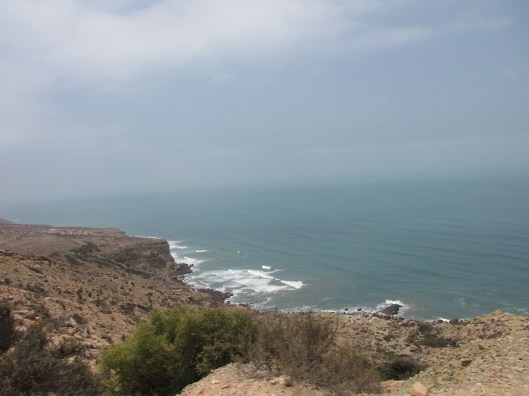
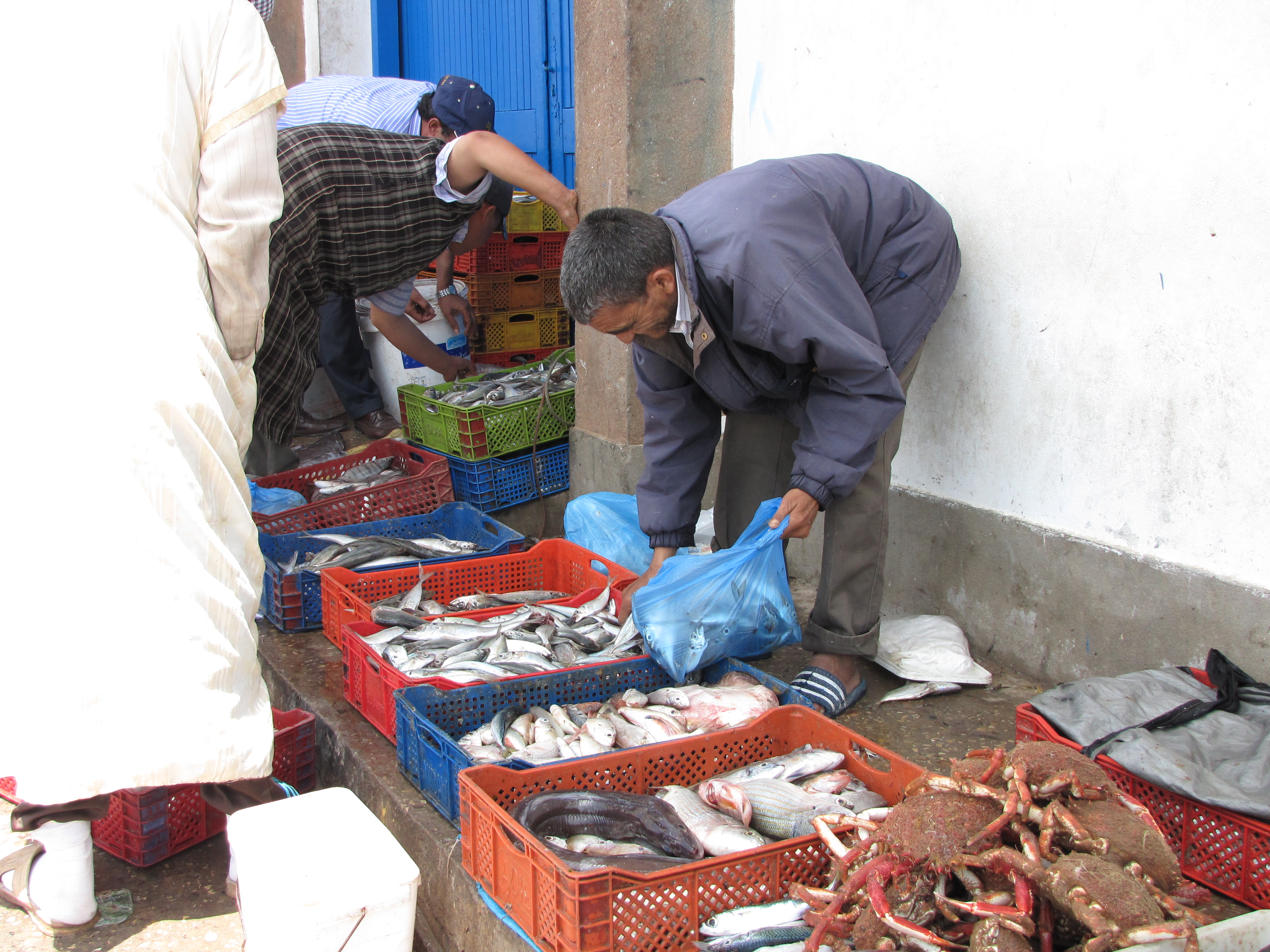
Essaouira has been my seaside town of choice. But after taking a trip to a remote town of Imasouan, near Agadir, I have changed my mind. Imasouan is enchanting, peaceful, and natural. No tourism; just Moroccan tourists. It’s all about fishing. And it’s all men. Very few women. Men in threesomes stand and untwist and unknot their nets to make them ready for the next trip out. Whole parking lots are used to spread out larger nets and straighten them. Beautiful blue wooden boats fill the parking lots (apparently the lots are for them) waiting for the next voyage. Fresh fish abounds and it’s not uncommon to see someone walking along the street carrying a huge red crab. Or to see someone sitting in the middle of the walkway chopping the heads off fish. It’s all fascinating and beautiful, and tranquil.

The tranquility of it all is more than I can describe. It swept over me like a wave and I felt my already-relaxed self sink even deeper into it. There is no souq, no medina. Just people living their fishing lives, laughing with each other, cutting up fish to sell, and grilling it to eat. Time stops here. From now on when someone asks me to think about the place I was happiest, or most relaxed, or most joyful, this is where I’ll be thinking about.

When she’s hot, Marrakech is HOT

Tags

, , , ,

Marrakech can be stifling hot. Like a wall of heat. Like a thousand wool blankets piled on you when you’re already hot. Like a furnace blowing too hot for too long. And I’m serious when I say: thank god it’s a dry heat! It makes it better than if it’s a humid heat. But sweat is sweat either way, and hot is hot either way. And it is hot. It was 40 degrees (104 degrees USA) the other day so we took to the seaside for some coolness. The temps dropped to a cool 29 degrees (84 degrees USA) over the course of the 2 hour trip. And with the wind, it was actually cold.
cropped-img_06931.jpg

Roads less traveled and goats in trees

Tags

, , , , , , , , , , ,

With my friend and co-traveler, Mokhtar, a native-born Moroccan and a tour operator, I am able to see things not every tourist gets to see. “Off-, off-road” we call it. He knows every nook and cranny of this country. And likely knows at least one or two people at every place we visit! Not an exaggeration. We were flagged through by a policeman the other day (I always give a breath of relief because you never know with the police over here) but suddenly an excited Mokhtar veered onto the shoulder where we were met at the car by the very policeman. Mokhtar jumped happily out of the car and the two embraced and kissed the four time-cheek kiss: the kiss indicating the two have not seen each other for a very long time (otherwise, a two time-cheek kiss would suffice). An old friend from his village, the two haven’t seen each other for at least 10 years. Another time we were in the middle of seeming nowhere and there’s Mokhtar sitting with his friend from his village. So we all sat for a fresh-squeezed orange juice. It happens every day. Even in these remote areas. It’s a small world, but it’s even smaller here in Morocco.

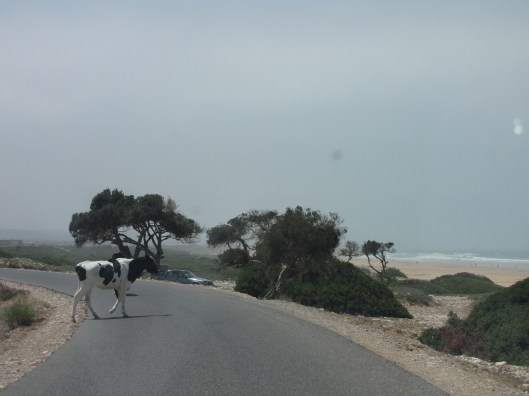
But that’s a digression. The point of this post is that we take the less-traveled roads on this trip. We discover areas that are new to both of us and that makes it all the more fun! The other day we took a day trip from Essaouira down the coast a bit so Mokhtar could show me some areas he had lived many years ago. We were on a narrow strip of tarred road barely big enough for one car. It went through some of the most spectacular countryside with the ocean visible at the tops of the trees and hills. Amazing beauty and unspoiled coastline! Miles and miles of it. Breathtaking.

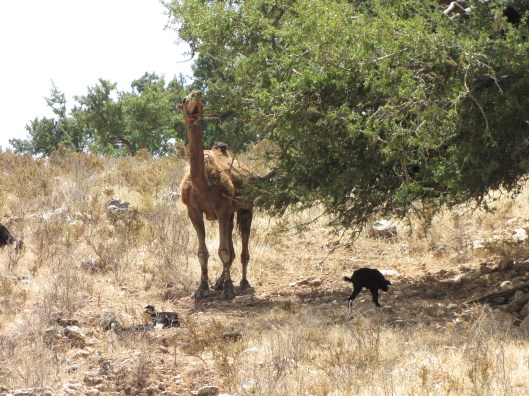
And all of a sudden, we came upon herds of goats milling through the argan trees – – and climbing them! And what noise they make! They practically inhale the argan nut from the tree and are able to climb to the very tops of the trees in order to do so! It’s amazing! The sound was really quite something. And all of sudden, there’s a camel! It seemed more like a giraffe, though, the way it reached up into the tree and compared to the goats at its feet, it was a giant. We squealed to a stop and both grabbed our cameras and took video and photos for the next 30 minutes. Prior to this I’ve only seen the staged-for-tourist goats in trees, not these honest to goodness climbers.

Rarely do tourists see this kind of thing on a run-of-the-mill tour. It takes a special guide and unique circumstances to find yourself in these spots!

IMG_1413
IMG_1407
IMG_0668
IMG_1330

IMG_1333

IMG_1359

IMG_1374

IMG_1377

IMG_1383

A different Morocco

Tags

, , , , , , ,

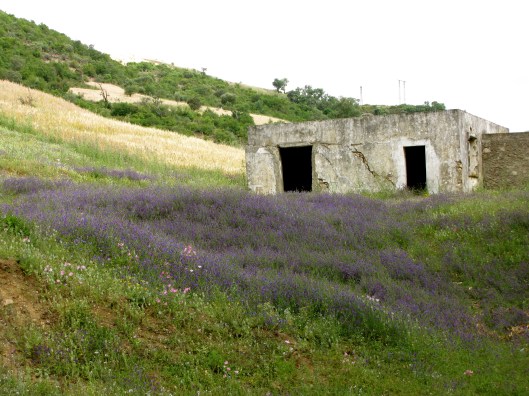
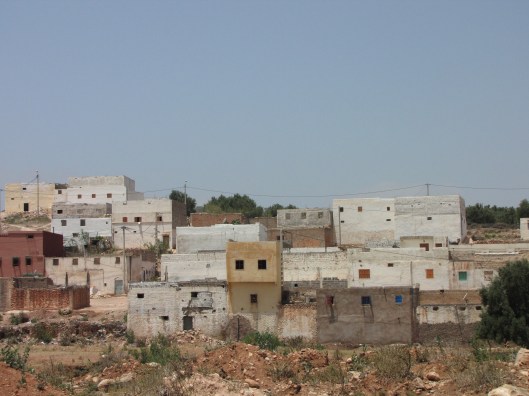
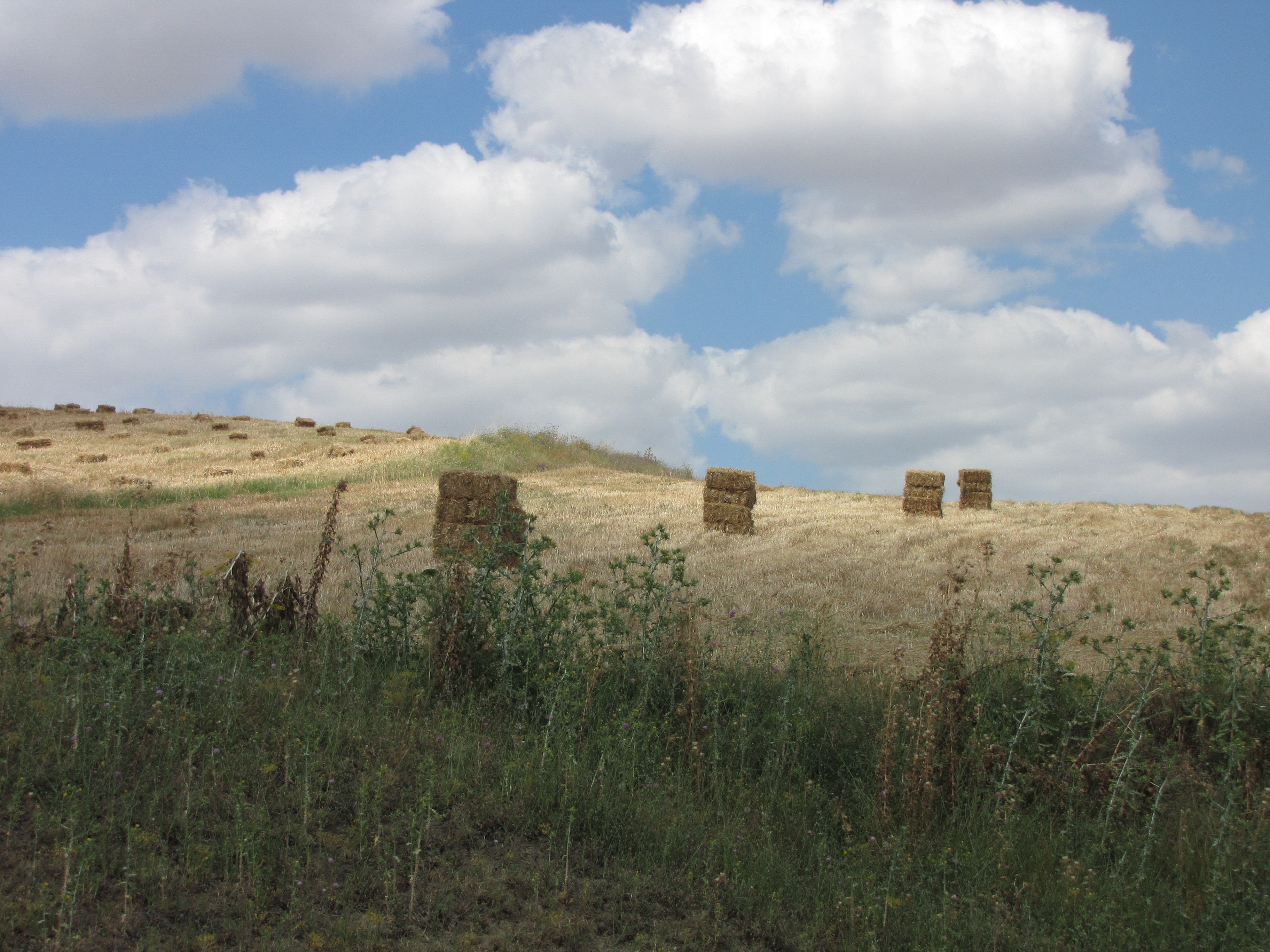
While tourism is Morocco’s main deal, agriculture ranks in there, too, although at only 14% of its total economy. But to look at the country as I have these past days, it seems like agriculture accounts for way more than just 14%. This place is vast! I have been surprised to see it all: olives and consequently olive oil, argan products, wheat, salt and oranges. And I’m probably leaving something out. Oh, fishing! It’s beautiful and often reminds me of midwestern USA.Image

Image

Image

Image

Standby Park, or the handyman park

There are parks in cities around Morocco where men gather each day, scattering themselves around a park in the center of town. In front of them they place their tools of the trade. A painter: a bucket filled with rollers and brushes. A home repair guy: a ladder (the fold-up kind) and other various tools. An electrician: wires and whatnot. A plumber: well, you get the picture.

There they sit. Waiting. So if I needed someone to do something for me, I’d go there in the morning, negotiate the price, and he’d come and do the work for me. Voilla! Cool concept.

The value of education

Tags

, , ,

It’s cliche to say, but education and our health are two of our most important possessions. Without either we don’t have much. Education is something I know I have taken for granted in my life. For one reason or another I didn’t apply myself when in school. I didn’t realize its value. And I’ve seen it happen to dozens of other people in my life: they choose to have fun more than to choose to learn.

In Morocco, there are thousands or millions of children living in the middle of seemingly nowhere who have no transportation to even get to their schools to learn. They walk or take a taxi or hitchhike each day to and from school. We picked up a girl and took her to school one day. Her walk would have been about 3 miles. We also picked up a young boy carrying a spiral notebook and took him 5 miles or more to his school. When we arrived at his school, there was nothing but boys milling about. That’s because girls are too valuable to have at home for housework and animal-tending to send to school. And also because the value of a boys’ education is greater than that of a girl’s to a family. It’s a fact. That’s how they think – – and I’m not saying that’s right or wrong. The fact that so many people believe it means there must be reasons for it. But it causes a literal ache in my belly to think of it. For one, it’s hard for the boys to get there. But for two, the girls aren’t even given a shot, in most cases. There is no transportation to and from school anywhere in Morocco. There are, though, social services that will provide vans and busses, but they are unreliable and sporadic. 

It makes me want to get a fleet of vans and help a community educate its children. But that would only be a drop in the bucket. 

Image

How to travel

Tags

, , , , , , , , , ,

You can be a tourist and get on a bus or van and go where the guide tells you to go, or you can travel and experience the people and the culture of a place. Either way, you make plans, but being a traveler, you let your day unfold as it will. As a traveler, you’re happy with however it happens. You’re willing to get lost.

I have the luxury of being a traveler because I’ve already been to Morocco and have already done the stuff the book recommends. (And because I have a Moroccan travel companion who’s in the business!) But I think it’s important to always add a bit of serendipity to a trip; to let things happen as they will. For example, it’s good to have a day in which you can sleep in, if you choose, or to run typical errands like you might at home. Meet the people with whom tourists never see! Be normal in a place. Talk to the people. Possibly get lost and make yourself have to rely on others to find your way!

I don’t think everyone is cut-out to travel for sure. It takes a lot of work to allow yourself to be free and to not worry: about how you look or how stupid you feel not knowing the language, or worrying about finding your way. But what I’ve learned is that someone will always help you. Always! So I say, get lost sometimes!

When in Chefchaouen, Morocco a few days ago, I became confused on the blue streets and alleyways; all of them looked alike! I have an excellent sense of direction but with all these blue doors and streets, it’s no wonder I couldn’t find the Hotel Parador. Or at least that’s what I thought the name of the hotel was where I was to meet Mokhtar after 2 hours of taking pictures. So after walking for what I knew was too long, I stopped and asked someone. He didn’t know English so I tried some French. It worked. He knew where I was to go. So off I went, following him past all the men waiting to get in to Mosque. He explained to each one he was taking me somewhere to show me my way, as if he needed to explain to these traditional men why he was walking with a woman, even though I tried to maintain a 3-step distance behind him.

He walked like he was in a race and I was exhausted within seconds! My god these people who are accustomed to walking in the desert or in hilly villages can walk! We proceeded into the market, me following trustingly behind. I looked to my right and thought, ‘That’s the way I’m supposed to go!’ but instead I followed, partly for the adventure of it and partly because I wasn’t sure of myself at the moment.

We got inside the market and he passed me off to another shop owner, wishing me good luck as I went on my way, blindly trusting man number 2. We walked, and walked, and walked inside that market, up steep hills like goats. Are you kidding me?! I kept thinking. But now I knew there was nothing more I could do except trust him. So when we got outside the market to another steep hill with a sign, ‘Hotel Parador’ at the top, I was devastated! This was not the hotel I was expecting to see. It looked like a rinky-dink hotel when the one I was looking for was palatial, with a big fancy pool and lots of public parking outside. I sat down on the steps and nearly started to cry. So disappointed and now getting a little scared because I had purposely left my phone, but now I had no way to contact Mokhtar to tell him I was lost. So I was feeling in a real pickle. “Maybe I told you the wrong hotel. Maybe I’m wrong,” I said to him. “Parking public?” I said to him. ‘Piscine et terrasse?’ I added desperately! “Oui, oui!” he emphatically assured, with the most beautiful smile! “C’est Hotel Parador! Oui!” So I sucked it up and took a deep breath and tackled the hill. We got to the top of it and my man, my savior, made a sweeping gesture to the parking lot and I hugged him and he said, “You said Hotel Parador and that’s where I brought you! To Hotel Parador!” I gave him some dirhams, probably a zillion too many, and we hugged and waved and said good-bye over and over and I calmly walked to Mokhtar as though nothing strange had happened. But he knew by my crazy sweaty hair and face that something was up!

It’s a good feeling to be out of control, to be at the mercy of strangers, to trust. To be free! It’s the adventure of travel! I see the good in others and I see the fact that we are all the same in the world. We are all the same. The same. Each and every one of us. It is really profound to me. And out of all the things in life so far, travel is the thing I think I value the very most. It is the singular thing that has taught me the most about others and about myself. If I someday have nothing, I have my memories and my experiences and I know that I have touched the lives of others as much as they have touched mine. It is very good. Tres bien.

IMG_0382

A juxtaposition

Tags

, , , , ,

In my experience, Morocco is a strange juxtaposition of extreme kindness and sweetness, to loud and robust anger – – followed by a hug and a kiss. The pendulum swings wide. One minute two people are screaming at each other in an intersection, the next they’re hugging and kissing with hands over their hearts. Or a driver nearly plows through a group of pedestrians and the next they’re all sweet and apologizing about who’s in the wrong, incha’allah. I think the language itself lends itself to that because it’s so up-and-down in intonation that it sometimes might sound angry when really it isn’t. And they use hand gestures that in the USA we would be inclined to say ‘calm down!’ But here? Normal.

Being here has taught me to calm down. Tranquil. Incha’allah. Things are going to happen as they are so I might as well calm down about it and take it slowly. I like it. I like not being in the rat race. Incha’allah.